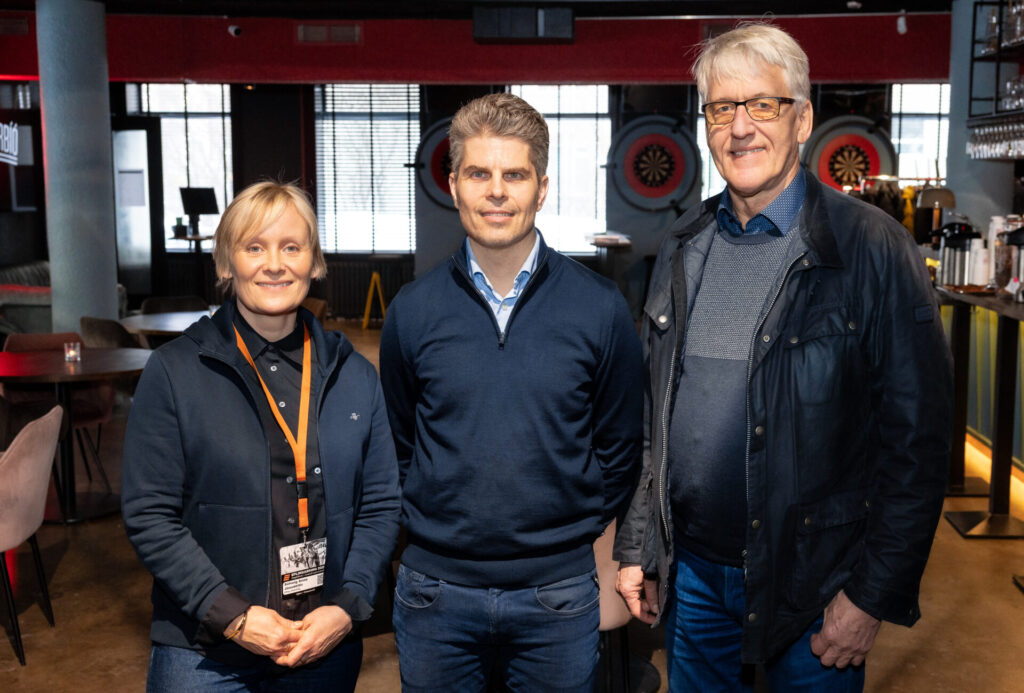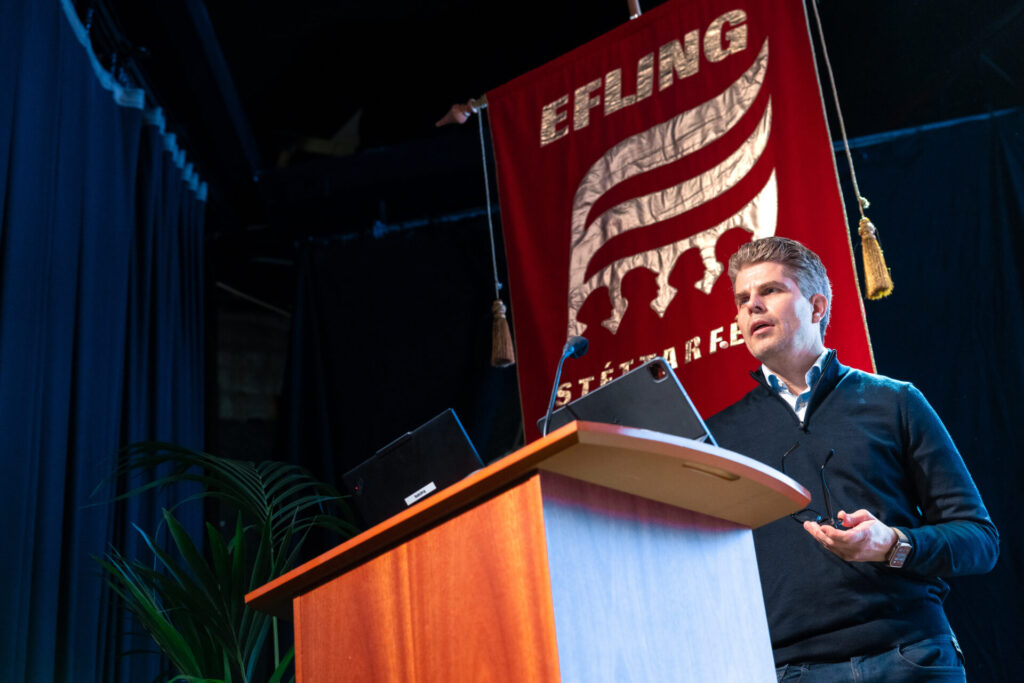
“We are sending a clear message that wage theft is a crime, not merely a breach of regulations.” This message lies at the heart of Norwegian legislation, where wage theft is defined as a punishable economic crime and can carry a sentence of up to six years in prison. This was highlighted in a presentation by Lars Christian Fjeldstad at the Efling congress today. Fjeldstad, a lawyer for the Norwegian Confederation of Trade Unions (LO), gave a detailed account of Norway’s experience with the legislation.
In his presentation, Fjeldstad explained how Norway became the first European country to introduce specific criminal provisions against wage theft, after a bill to that effect was adopted in 2021 and came into force at the beginning of 2022. He noted that the origins of the legislation can be traced to a proposal from Fagforbundet, Norway’s largest trade union, which was supported by both LO and the Norwegian Labour Party.
Up to six years in prison for wage theft
Fjeldstad explained that under the law, employers who deliberately withhold wages, holiday pay, or other payments may face up to two years in prison, or up to six years in cases involving serious offences.
“The legislation is intended, among other things, to prevent those who engage in wage theft from gaining a competitive advantage, but equally, and at the same time, to protect workers who are often in a vulnerable position,” Fjeldstad said.
He pointed out that the provision applies to both statutory and contractual rights, including overtime pay, holiday entitlements, and other payments.
Intent is key
In his presentation, Fjeldstad emphasised that the law targets deliberate violations. “We are not punishing honest mistakes,” he said, explaining that genuine misunderstandings or disputes over the interpretation of rules generally fall outside the scope of criminal liability.
“But when an employer knows they are committing wage theft to profit, that constitutes a criminal offence,” he added.
Fjeldstad reviewed several examples from Norwegian courts, including a case in which an employer was convicted of underpaying an employee by millions of kroner, as well as the so-called Fibertec case, in which a CEO received an unconditional prison sentence for large-scale wage theft.
He also drew particular attention to a recent appellate ruling from January 2026, in which systematic underpayment affecting 13 employees was treated as a single continuous offence. “The court rejected the idea that financial difficulties could justify such conduct,” Fjeldstad said.
Strong opposition in Iceland is hindering legislation
In the discussion following the lecture, Sólveig Anna Jónsdóttir, chair of Efling, noted that the amounts mentioned by Fjeldstad were not unlike those seen in Efling’s cases in Iceland. The difference, however, lies in the fact that criminal sanctions in Iceland are much weaker.
Fjeldstad also noted that in Norway, there had been a broad consensus on the need for such legislation and that it had not faced significant political opposition. Sólveig Anna said this stood in stark contrast to the situation in Iceland, where attempts to introduce similar laws have met strong resistance.
She said she found this difficult to understand, given that she is convinced there is overwhelming public support for such legislation. “The pressure exerted by payers of wages on politicians is such that it almost resembles organised crime,” Sólveig Anna said.
The need for similar legislation in Iceland
Wage theft has been widely discussed in the Icelandic labour market, particularly in connection with the situation of foreign workers and undercutting in certain sectors.
Fjeldstad’s presentation and the subsequent discussion indicate that clear and unequivocal legislation, defining wage theft as a criminal economic offence, would be a powerful tool for protecting workers’ rights and promoting fairer competition.
Such legislation is necessary in Iceland, as it would strengthen the position of workers and set firm boundaries that wage theft will not be tolerated. Efling calls on the authorities to act without delay and follow the example of Norway.