
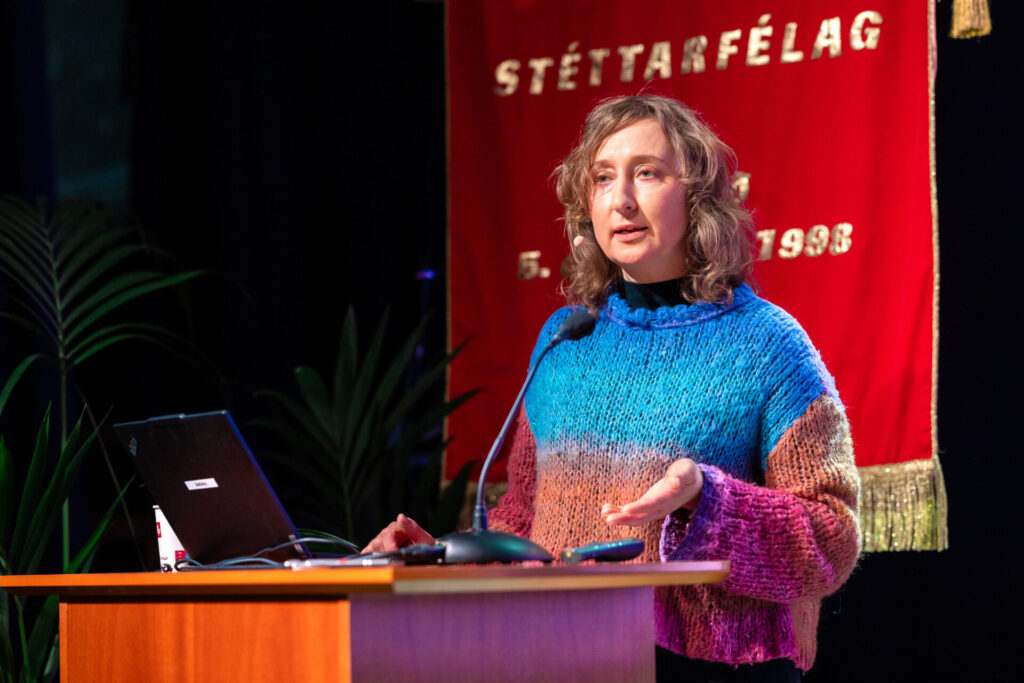
“The fight of workers at Emeis, the largest private provider of long-term care in Poland, clearly shows us how much organised union action can achieve, even under difficult conditions and strong employer resistance,” said Anna Bacia, chair of the Polish care workers’ union OPZZ-KP, at the Efling congress today.
OPZZ-KP was established at the end of 2018, and the first years were marked by conflicts and systematic opposition from employers, Anna explained. The workers’ struggle was not isolated, however; it received support from the international labour movement and backing from patients and their families, including petitions and protests outside care homes.
Achievements Despite Resistance
Anna herself was dismissed in 2019 after taking on a position as a shop steward at Emeis, another example of the company’s strong opposition to the union and employees’ attempts to secure their rights. She explained that, fortunately, she received substantial support; protests were held outside care homes and elsewhere, and Uni Global Union provided strong backing.
“For two years, OPZZ-KP had to operate almost ‘underground’ under very difficult conditions. Our members were afraid to take up shop steward positions for fear of losing their jobs. But in 2021, the situation changed when I was reinstated by court order. This marked a new chapter in the struggle,” she said.
“In 2022, a cooperation agreement was signed, and formal negotiations with the company began. At the same time, the strength of the union grew, both in numbers and influence. Members organised collective actions, gathered data and demands, and built pressure in a systematic way,” she added.
Clear Demands for Improved Conditions
In March 2025, formal wage negotiations began with clear demands, which Anna Bacia highlighted specifically:
- Wage increases for staff outside healthcare professions
- Seniority-related payments
- Bonuses and additional payments
- Recognition and improved status for care workers
“These demands reflect the reality that workers in the care sector face, where wages are low, and the workload is heavy,” she said.
Anna Bacia emphasised that the struggle had evolved from a defensive fight into a visible and public movement. “Workers have stepped forward openly, including on social media, and made their demands visible.”
Despite this, mediation concluded in February 2026 with a statement of disagreement. The next step under discussion is strike action. She asked: “Are workers ready to go on strike to achieve justice?”
Nationwide Solidarity is Key
The struggle has also expanded. Poland’s largest union federations have formed solidarity and worked on a proposal for a collective agreement covering the entire care sector.
“This work has already yielded results, including increased dialogue with authorities and coordinated policy-making among unions in both the public and private sectors,” said Anna Bacia.
Clear Lessons for Iceland
“The experience from Poland shows that results are not achieved without struggle. It requires organisation, perseverance, and solidarity. It also shows that even in difficult environments, it is possible to build a strong labour movement that drives change,” she said, adding:
“For the Icelandic labour market, this is a reminder of the importance of defending workers’ rights, especially in sectors where vulnerable groups are employed, and the risk of abuse exists. When employers refuse to negotiate and respect workers’ demands, workers must be ready to use their strongest tools.”
“The fight at Emeis in Poland is far from over, but it has already shown that solidarity is essential and that change only comes when sufficient pressure is applied,” Anna Bacia concluded.
Efling Members Also Been Dismissed
In the discussions following Anna’s speech, Sólveig Anna Jónsdóttir, chair of Efling, noted that Efling members have also been dismissed from work for participating in labour struggles, and that such members were among those present in the room that day. She also explained that Efling had offered and was ready to assist Anna and OPZZ-KP in their struggle.
Asked whether the union had received any support from the Polish authorities in its fight, Anna Bacia replied that it had not: “We have to fight for all our rights and wage improvements ourselves.”