
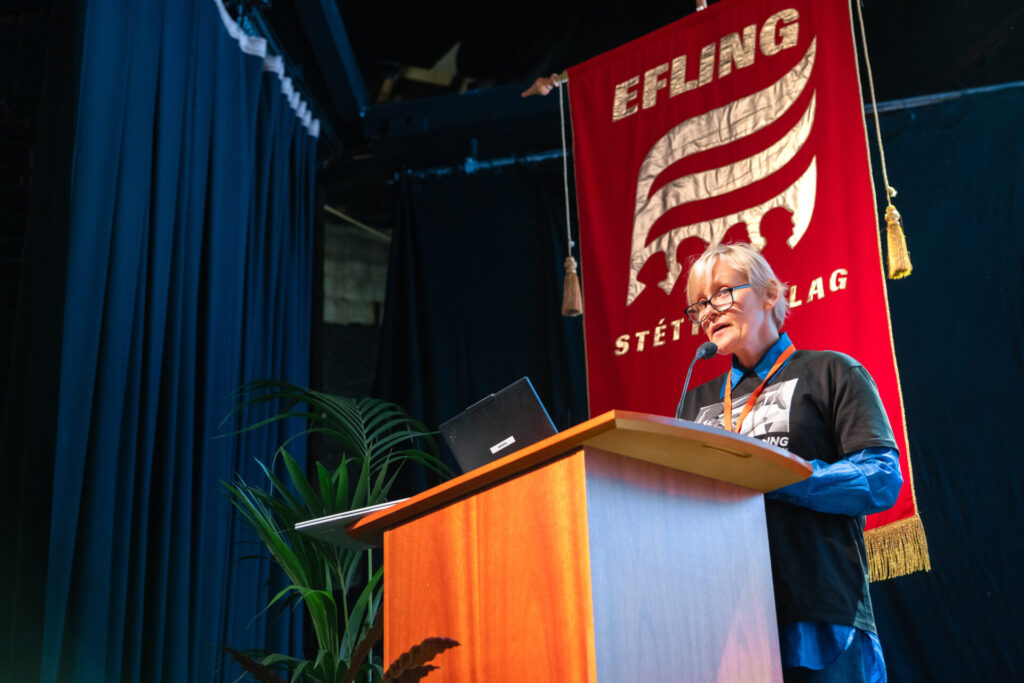
Good afternoon, dear comrades,
I warmly welcome you all to the first-ever Efling Congress. I am truly delighted to be here with you, indispensable people in all value creation in our society, indispensable people who sustain the welfare systems of the capital area, indispensable members of our union, Efling.
Before I say more, I would like to ask you to do one thing. I ask you to pause and look around you, across the hall. Look at the people sitting at your table, and at those all around you. Look at this large group, a diverse group, a remarkable group, a strong group. When I look at you, I feel pride in being in the same union as you, pride in being entrusted with serving as chair of our union, the largest union of workers in Iceland, the most powerful union of workers in Iceland, with the strongest membership. What we see here when we look around is not just individuals; no, we see something far more powerful. We see the people who keep society running through their work. The backbone of our society. The backbone of the struggle for a just Iceland.
Dear comrades,
Since we began, in 2018, to transform Efling from a closed office stronghold where the voices of working people were not meant to be heard, into an open and democratic community of Efling members where all are welcome, we have been fortunate to always focus on what unites us, never what divides us. We live in a world where we are constantly told that people should divide themselves into ever smaller and narrower groups, groups based on gender, origin, skin colour, religion, sexual orientation, and so on, messages telling us not to build bridges between workers but to build walls, walls that keep us apart and reduce our chances of succeeding in the struggle for a better life for ourselves and our families.
At this first Efling Congress, as in all our work, we reject that vision completely and decisively. We come together here to remind ourselves, and Icelandic society, of one of the most important truths of our lives: we are strongest when we stand together, work together, fight together, and win together. We are strongest when we recognise and remember what unites us, that we are the workforce of the capital area, the people who drive the wheels of the economy and create growth. We will, of course, enjoy our time together here, meet old friends and make new ones, eat and drink together, and joke and laugh. But above all, we will engage in serious discussions about serious issues, issues that affect all our lives because of our position in society. Together, we will shape the union’s stance on the major issues that matter most to working people, that have the greatest impact on our lives and living conditions.
Because the truth, as we all know, is that we face numerous and serious challenges and obstacles, obstacles created by class divisions in society and the inequality that inevitably follows, even in countries that call themselves Nordic welfare states.
But the truth is also this, and we know it well: working people have always faced obstacles, then and now. The ruling class of society always tries to prevent recognition of what should be an indisputable truth: labour, the workforce, creates the wealth of society. When we look back, we see that the history of working people, both here and in other countries, many of which you come from, is not a story of easy lives and privilege. No, it is a story of struggle. A story of sacrifice. It is a story of people who lacked power and wealth, who faced what seemed like insurmountable obstacles, yet who, through solidarity and an unshakeable belief that labour is the source of all wealth and progress, forged their way forward without giving up, for the benefit of the societies they built, for the benefit of all. That solidarity, that conviction and belief, is what we must build our struggle upon. Then we, too, like those who came before us, will succeed. Like them, we say: only the struggle of workers themselves can create the pressure needed to move closer to justice. Employers and governments will never show workers the respect they deserve until workers themselves come together, as a large and organised force, and demand that respect.
Dear comrades,
The history of working people and the struggle of the working class is not only an old or distant story. It is also our own experience, the story of recent years, of the past month, of yesterday. Think about what we have achieved together in recent years. Let us remember it and hold our heads high; we are the vanguard of the Icelandic labour movement. That is a fact no one can deny.
Behind me, we see images of what we have done since 2018. We have not been idle, far from it. An incredible amount has happened, so much that it is impossible to cover it all here. But let us recall a few moments. In 2019, we launched the first strikes by workers in the capital area in decades on International Women’s Day, 8 March, and the first strikes in Iceland’s history led by hotel housekeepers. That day, nearly one thousand housekeepers, mostly migrant women from all over the world, walked out. They left their workplaces, where they came every day to create value for hotel owners, after voting for industrial action, with 89% voting in favour.
The strike on Women’s Day in 2019 was only the beginning. We reignited the embers of real labour struggle in Iceland, embers in a fire many believed had burned out, a fire we fuelled with our strength and determination. In the winter of 2020, Efling members working for the City of Reykjavík, indispensable people who keep the city running through demanding physical and emotional labour in preschools, home care, shelters, waste collection, and more, heroes of Reykjavík, showed society the power of solidarity. When the city’s negotiating committee refused to meet our demands to raise the lowest wages and correct the historic undervaluation of women’s work, we held a strike vote, 95.5% voted yes. The entire city felt our strength and importance. “The city is in our hands,” we said, and we proved it beyond doubt: almost all preschools closed, and no one could question the importance of Efling members who keep them running every day.
And at times when others would have given up, Efling members did not hesitate; we kept going, straight into the storm. In 2023, we faced a coordinated attack by the labour movement establishment, employers’ organisations, the government, and the state mediator on our legal and constitutional right to negotiate our own collective agreements. The state mediator, backed by the most powerful figures in society, tried to force us into submission, took us to court in an attempt to seize our membership register to carry out an unlawful vote on an unlawful proposal. There was an attempt to strip us of our democratic rights, to undermine our right to decide on one of the most fundamental issues imaginable, the price of our labour. Everything was tried. Yet the outcome was this: Efling members stood upright and unbroken, while the state mediator and the director of the Confederation of Icelandic Enterprise were forced to resign, having lost all credibility after sacrificing their integrity in an attempt to break us. That winter, we showed everyone that real democracy lives in the strength and solidarity of workers, not in the offices of compromised officials serving capital.
I move quickly through this history; there is no time to cover everything, but I must mention the struggle of Efling members working in nursing homes in the capital area last winter. Their unity was extraordinary and delivered significant gains for more than 2,000 members, including special wage increases similar to those we secured with the City of Reykjavík in 2020. We concluded the first independent collective agreement for this large group of indispensable workers. The reason for that success was a courageous and disciplined group of Efling members who led negotiations and never gave up. That kind of strength cannot be defeated.
Dear comrades,
In recent years, we have not only had to confront employers and the Icelandic ruling class, but we have also had to deal with serious problems within the labour movement itself. Problems linked to the fact that the movement had abandoned genuine labour struggle and instead focused on securing even better conditions for those already well off, ensuring that workers themselves had no direct role in collective bargaining, leaving it entirely in the hands of university-educated specialists and their spreadsheets. Our fighting spirit and militant approach exposed deep ideological disagreements about how best to fight. That exposure was necessary and long overdue.
From the very beginning in 2018, we faced strong opposition, and from day one, we have had to make difficult decisions. The first question we had to answer was this: would we allow the office structure to contain us, to keep us locked in and preserve the status quo, the continued powerlessness of workers within the labour movement, or would we challenge entrenched and harmful traditions that do not serve workers’ interests, that work against them? Would we go our own way, independent and bold?
Our answer, that we would go our own way, caused upheaval and created serious challenges. But we never strayed from our path, and we never gave up. That is why we have built a real position of strength. That is why we now command respect. That is why our voice can no longer be ignored. We broke the silence that had settled over the labour struggle in the capital area. We refused to stay quiet, in the corner, at the back of the line. We rejected the idea that the only role of workers is to toil so others can prosper. We rejected the old leadership and the corruption and self-serving practices that had taken root in our union. We transformed the conversation. We stepped out of the shadows and into the spotlight, united, strong, proud. We refused to complain and present ourselves as victims. We said clearly, so everyone had to listen: we create the value, we are indispensable. We are the force that can stop everything, and therefore we are the force that can move society forward, make it better, more equal, more just.
Dear comrades,
This brief account proves one thing beyond doubt: when we come together, organised and determined, we are strongest. And as we have built our union into the leading organisation of workers in Iceland, we have always made time to come together in friendship, joy, and celebration. Christmas events, May Day celebrations, food and culture, these moments with friends and family strengthen our bonds, inspire us, and sustain us when we face challenges.
Dear comrades,
We must all be clear about what this congress is, and what it is not. If we look at Efling’s statutes, there is no mention of an Efling Congress, and therefore, it has no formal status. This congress is, in fact, an experiment, a journey into uncharted territory, initiated by the union’s board in cooperation with the council of shop stewards.
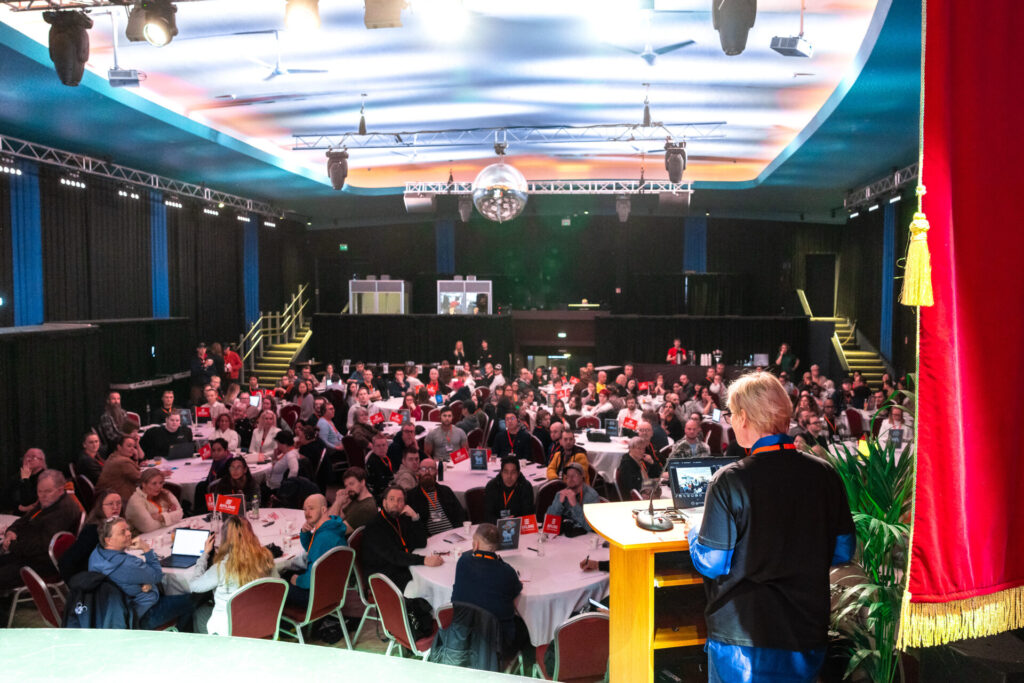
As we now open this congress, I feel great anticipation. Two hundred Efling members are here as delegates. Most are already active in the union’s social and political work: shop stewards, board members, representatives of the council, people who have taken part in negotiations, strikes, and struggles, gathered here to discuss important, highly political issues and reach conclusions.
We are experienced people, and we know that the first attempt is rarely perfect. We may encounter minor organisational issues, and there may be moments where we must work together to resolve unexpected situations. That is why we must show each other patience and, above all, remain constructive and respectful. We are not here to argue or quarrel; we are here to talk and to listen. If things do not go exactly as planned, we will not overreact. We will focus on finding solutions together and move forward.
If things go well today and tomorrow, which I am confident they will, it is not unlikely that this congress will be held again and become a strong part of our union’s democratic renewal.
Dear comrades,
I am fully aware that many issues weigh heavily on us. Housing costs, for both renters and homeowners, weigh like a nightmare on our members and their families. Wage theft and breaches of collective agreements remain persistent problems that the ruling class refuses to confront, because its members are not the victims. Working conditions and the many challenges we face at work undermine our quality of life, causing stress, insecurity, and concern.
These are the issues we will focus on. The board and the council have prepared thoroughly, and based on members’ input, four key topics have been selected:
- Housing: conditions for buyers and owners
- Housing: conditions for renters
- Wage theft and violations of collective agreements
- Empowerment in the workplace
However, while these four topics are central, we can and should discuss everything that matters to Efling members. This is our congress, our space, our union. We will have open and honest discussions, perhaps not about absolutely everything; we might save some of that for the congress dinner, but about almost everything.
At the same time, to maintain focus and ensure clear outcomes, we should collectively prioritise these four topics.
We have before us four well-developed proposals, shaped by the council after extensive discussion. We must focus our collective energy on producing strong, unified, or near-unanimous statements from the working groups. Each group’s goal is to seek consensus while ensuring all voices are heard.
But let it be clear: even if ideas do not become formal resolutions here, they will not be lost. Group leaders and secretaries will record all ideas and reflections, even those not directly related to the resolutions, so that we have a reliable record of what mattered most to Efling members at this congress in February 2026, for future work.
Let me say a few words about democracy. It is often presented as nothing more than rules, laws, and periodic votes. These are important, of course. But real, living democracy is a combination of two things: formal rules and active participation in shaping decisions about where we are going, why, and how. And for that to happen, people must feel heard, welcome, respected, and that their voice truly matters.
We in Efling could have the most perfect statutes in the world, but if our members do not feel welcome, if they feel their views are not taken seriously, then we have failed. Then those statutes are not worth the paper they are written on. Democracy is about building real participation, about creating spaces like this, where people want to take part because they know they are heard.
As we begin this historic congress, let us remember this: we speak with passion and conviction. We may disagree, that is how we learn to speak, listen, explain, and understand. That is how we sharpen our ideas. But we must never forget that we are on the same team, today and tomorrow, and if we remember that, we can be on the same team every day.
Because the struggle ahead, like the one behind us, will demand unity and deep solidarity. It will require us to face the real obstacles in our way: capital that believes it can control everything, a political class that prioritises the wealthy over justice, and employers who ignore what we need.
And we will say, so loudly that no one can pretend not to hear or understand, with one voice:
We are the workforce.
We create the value.
We are indispensable.
We are Efling.
And we are unstoppable when we decide to stand together.
We will make this first Efling Congress a great success. Since 2018, we have been writing the history of workers in the capital area. Now, let us begin the next chapter.
I hereby declare the first Efling Congress open.