
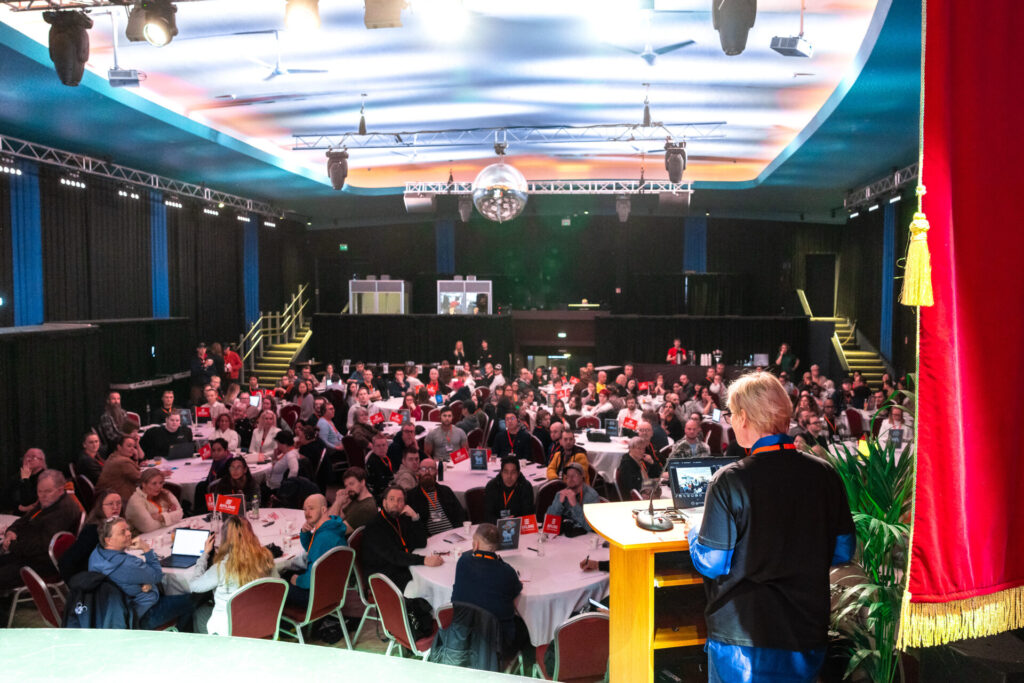
Members of Efling are calling on the government to ensure secure access to home ownership for working people and to recognise housing as a human right rather than a financial asset.
This is the underlying tone of the Efling Congress resolution, which was adopted on the final day of the congress, 27 February. In the resolution, the union stresses that housing security is a cornerstone of welfare and that the current situation, where many face instability and high costs, is unacceptable.
Among the key demands are stricter regulations to curb housing speculation, including higher property taxes on third and subsequent homes and restrictions on short-term rentals. The union also calls for limits on investors buying up residential properties and for measures to ensure that housing primarily serves people living in the country.
Efling further demands a clear, funded government plan to build around 4,000 homes annually, developed in cooperation with municipalities. The plan should ensure sufficient land supply and remove planning barriers.
The union also calls for more realistic mortgage affordability assessments, lower interest rates, and caps on real interest rates. In addition, it proposes that municipalities build homes to be sold at cost price, that a sufficient share of new housing be reserved for first-time buyers and working people, and that mortgage interest relief be expanded.
The full resolution can be read below.
Home Ownership
Housing security should be a cornerstone of workers’ welfare. The home is the place where working people recover their strength after a hard day’s labor. The home is the family’s refuge, where children are raised, and relationships are nurtured. The home is part of a wider community—an apartment building, a street, a neighborhood—connected to the preschool, the primary school, the sports club, the swimming pool, and social life. Feeling well at home and knowing it is a secure sanctuary for the future is of immeasurable value. Children who experience rootlessness carry it with them into the future, which can lead to dropping out of school, instability, and social problems.
Securing a roof over one’s head should not be a source of anxiety, insecurity, and distress, or lead to incapacitation for work due to those reasons. Working people should not have to fear frequent relocations, that their residence depends on the landlord’s whim, that children must repeatedly change schools and groups of friends, or that housing costs will suddenly rise to the point where it becomes difficult to afford necessities.
It is the demand of Efling members that the Icelandic state guarantee working people with permanent residence in Iceland secure access to home ownership. This should not be a privilege reserved solely for the middle class and those who inherit housing support.
Efling members make the following demands of the Icelandic authorities regarding home ownership:
- Housing is a human right, not a source of speculation. Stricter regulations must be introduced at all levels to combat housing speculation for example, by increasing property taxes on a third property and beyond, except in the case of non-profit rental housing companies and the conversion of residential housing into profit-driven short-term rentals.
- Usable residential housing that already exists must primarily serve the people of the country, and this must be ensured through effective regulations and incentives that deliver results. The person who purchases an apartment must be a taxpayer in Iceland.
- According to the Housing and Construction Authority, approximately four thousand homes must be built annually in the coming decades. The government must establish a time-bound and funded plan for increasing the housing supply and implement it in cooperation with municipalities and residents’ associations so that the residents living there are taken into consideration. It must be ensured that sufficient land is available and that planning obstacles are removed. Such a plan must be realistic and based on the best possible forecasts for population development in the decades ahead. New housing must be built in a human- and family-friendly manner. Time limits shall be set on the use of plots after the building rights have been purchased. The state shall ensure that the rules are enforced.
- Housing loans are an inevitable part of acquiring a home. Efling’s members call for sensible rules regarding the implementation of affordability assessments. Those who are already demonstrably able to sustain high rental payments should have their repayment capacity assessed. Creditworthiness assessments should be based on real circumstances rather than artificial benchmarks.
- The current high-interest-rate policy is intolerable. It is deeply disappointing that the government’s promise of an interest-rate hammer has turned into an inflated interest-rate bubble that continues to expand. The government must take decisive action and present a realistic, time-bound, and detailed plan for reducing inflation and exiting the high-interest-rate environment within the next two to six years. Efling’s members support the involvement of labor market parties in such a plan, as it should focus on protecting the interests and improving the position of working people. Limits should be set on how high real interest rates banks can charge on housing loans.
- It must be ensured that a sufficiently large proportion of newly built housing is allocated to first-time buyers and workers.
- Municipalities should build apartments to sell at cost price.
- The rules on interest subsidies need to be expanded.
Additionally, Efling members demand of Gildi pension fund that the fund advocate within the pension system for more favorable mortgage terms for fund members.